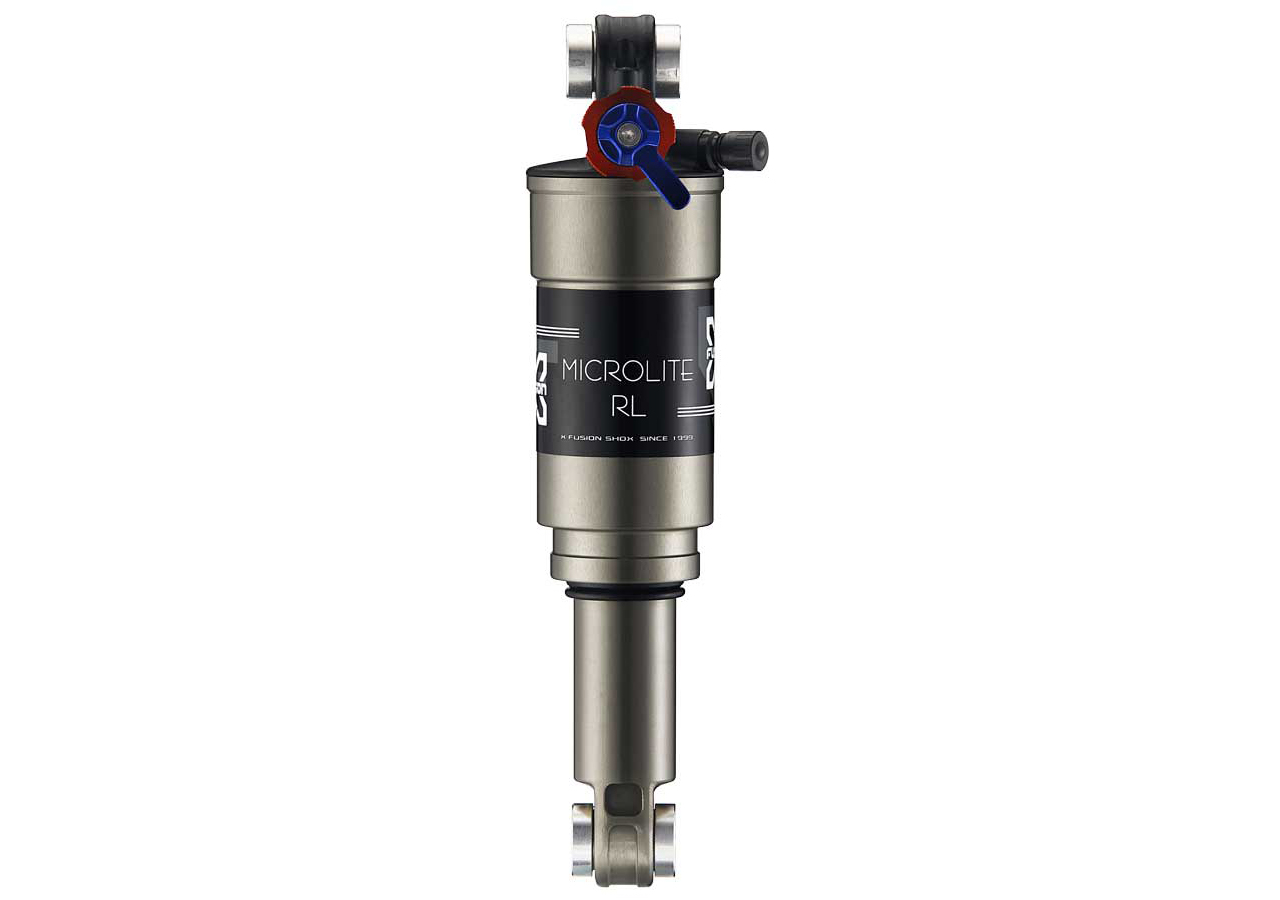
As the name suggests, the Microlite shock is designed with weight reduction in mind. Our 184x44mm sample hit the scales at 195g saving around 50g when compared to a regular inline shock.
X-Fusion makes a wide range of suspension components and most are very
adjustable. The Microlite however is a pared down and simple offering. The main
air spring is tuneable (as you’d expect) and the rebound can be set to match
the spring rate. There’s also a lockout lever but that’s about it. You won’t find any low speed
compression adjustment or threshold settings – it’s either ‘on’ or ‘off’ and
nothing in between.
Compared to the current generation Fox Float rear shock (a product that
many will be familiar with), the Microlite has an inherently progressive spring
curve. It starts out supple but ramps up to offer plenty of bottom-out
resistance.
Of course your frame kinematics will always play an important role in
how a shock feels. Most shorter travel XC bikes tend to have a linear or
regressive leverage ratio. This makes them firmer in the early travel while
still moving for mid-sized bumps but it doesn’t afford lots of bottom out
resistance. The progressive nature of the Microlite is well suited to this type
of bike; it adds suppleness over smaller bumps but doesn’t slam to the bottom
or wallow excessively when pushed. Despite its diminutive size I had no issues with the shock on long and
rough descents – it performed very well. However, if your suspension
arrangement is progressive to begin with, you mightn’t use all of the available
travel – even on the biggest hits. With the Microlite there aren’t any
large volume air canister options; it simply isn’t as tuneable as a heavier,
fully featured shock.
At $480 the Microlite is well priced for a high quality rear shock and
its performance should provide a good match for most modern XC platforms. It’s
worth considering if you’re focused on weight reduction and happy to forgo some
tunability.
PRICE 480$